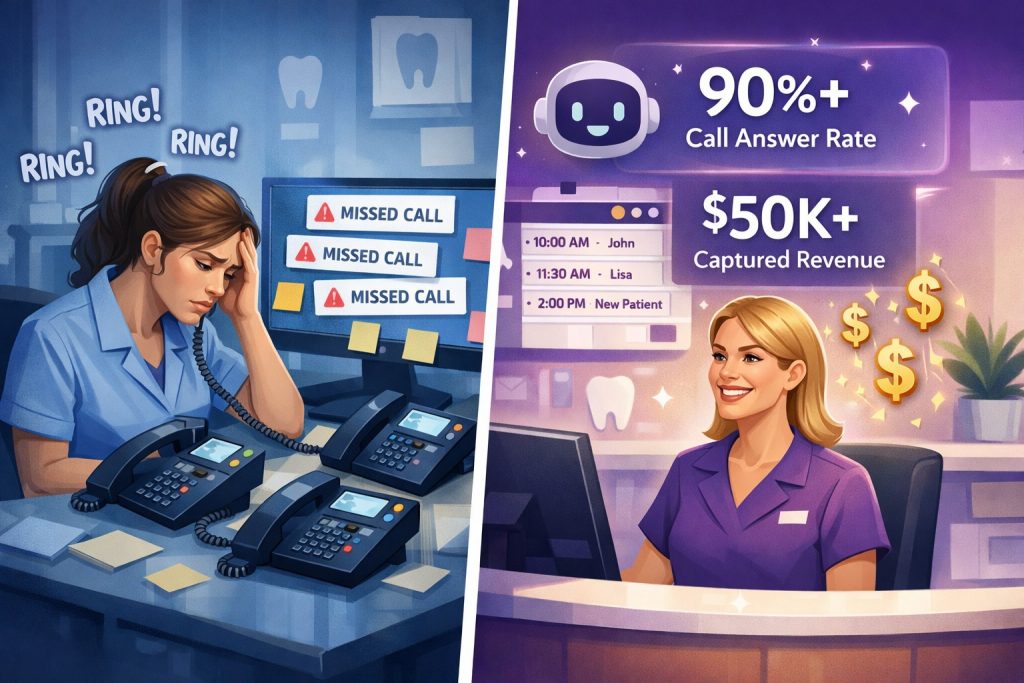
💰 Stop Losing $100,000+ Annually From Missed Calls
Dental practices miss 30-38% of incoming calls during business hours. Each missed call costs $850+ in first-year patient revenue. AI receptionists answer every call 24/7 for less than $300/month.
⚡ Quick Comparison: Top 5 AI Receptionists for Dental Offices
| Solution | Starting Price | 24/7 Availability | PMS Integration | Multilingual | Setup Time |
|---|---|---|---|---|---|
| MissNoCalls | Custom pricing | 6,000+ integrations | Included | 2-5 days | |
| Arini AI | Contact for quote | Major PMS | 1-2 weeks | ||
| Viva AI | Contact for quote | Major PMS | 1-2 weeks | ||
| HeyGent AI | Contact for quote | Major PMS | 1 month trial | ||
| TrueLark | Contact for quote | Major PMS | 1-2 weeks |
🏆 Top 5 AI Receptionists for Dental Practices in 2026
1. MissNoCalls
MissNoCalls delivers fully customizable AI voice solutions tailored specifically to your dental practice’s unique needs. Unlike one-size-fits-all platforms, MissNoCalls builds custom conversation flows, integrates with 6,000+ business applications, and includes advanced features like voice cloning at accessible price points for small and mid-sized practices.
✓ Strengths
- Highest level of customization for unique practice workflows
- Transparent pricing without hidden per-call fees
- Broader integration ecosystem beyond just dental software
- Voice cloning creates natural patient experiences
- Ongoing consultation and support as your practice grows
− Considerations
- Custom setup requires initial consultation time
- More features may need brief learning period
- Best for practices wanting tailored solutions vs. plug-and-play
💵 Pricing
Custom Pricing
Tailored to your practice size and needs. DIY and full-service setup options available. Typically 50-70% less than enterprise-focused competitors while offering more customization.
Best For: Small to medium dental practices seeking customizable AI solutions at accessible prices. Ideal for practices with unique workflows, multiple service offerings, or diverse patient populations requiring multilingual support.
Schedule Free Consultation2. Arini AI
Arini specializes exclusively in dental practices with training based on 700,000+ hours of actual dental conversations. The platform handles both inbound calls and outbound campaigns, making it powerful for practices needing comprehensive patient engagement beyond call answering. According to research from Arini, practices report $56,000+ in new patient appointments within the first month.
✓ Strengths
- Dental-specific AI trained on real practice conversations
- Proven ROI with documented case studies
- Handles complex multi-location operations
- Strong outbound campaign capabilities
− Considerations
- Pricing not publicly available requires quote
- May be overkill for solo practitioners
- Setup takes 1-2 weeks vs. faster options
💵 Pricing
Contact for custom quote based on practice size and call volume. Typically positioned at premium pricing tier for medium to large practices.
Best For: Multi-location dental groups (DSOs) and high-volume practices needing robust outbound calling for recall campaigns and appointment confirmations.
3. Viva AI
Viva AI positions itself as an “AI Office Manager” extending beyond phone calls to handle SMS, web chat, email management, and even payment collection. The comprehensive approach appeals to practices wanting to automate their entire front desk operation through a single platform rather than juggling multiple tools.
✓ Strengths
- Most comprehensive feature set beyond call answering
- Unified patient communication management
- Strong analytics for practice optimization
- Handles multiple communication channels seamlessly
− Considerations
- Higher complexity may require more training
- Premium pricing for comprehensive features
- No multilingual support mentioned
💵 Pricing
Contact for quote. Broader feature set suggests higher pricing than pure call-answering solutions. Best value for practices wanting to consolidate multiple tools.
Best For: Practices wanting comprehensive front-office automation beyond phone coverage, particularly those struggling with email backlogs and manual patient outreach.
4. HeyGent AI
HeyGent emphasizes extensive customization options and multilingual capabilities for diverse patient populations. The platform serves individual practices through DSOs with multi-location support. Their unique trial model starts billing only after the first booked appointment, reducing initial risk.
✓ Strengths
- Strong multilingual capabilities for diverse communities
- Highly customizable for unique practice needs
- Risk-free trial model with no upfront commitment
- Trained on 700,000+ hours of dental conversations
− Considerations
- One-month trial period longer than competitors
- Pricing not transparent, requires consultation
- May require more setup time for customization
💵 Pricing
Custom pricing based on practice size. Trial begins only from first booked appointment. Emphasizes 3-5x ROI within first year based on captured revenue.
Best For: Practices serving diverse patient populations requiring multilingual support, and practices wanting extensive customization options.
5. TrueLark
TrueLark serves as an established player with proven reliability in dental practices. The platform emphasizes consistency and programming each office’s custom service manual into the AI. Strong fit for DSOs and DPOs requiring centralized communication management across multiple locations with standardized processes.
✓ Strengths
- Proven reliability and established track record
- Strong DSO/DPO multi-location support
- Consistent service standards across locations
- Testimonials emphasize new patient conversion
− Considerations
- May lack cutting-edge features of newer competitors
- Pricing requires consultation, not transparent
- Focus on reliability over innovation
💵 Pricing
Quote-based pricing for practices of all sizes. Positioned competitively but requires direct consultation for specific costs.
Best For: Practices prioritizing proven reliability over cutting-edge features, particularly DSOs needing consistent standards across multiple offices.
🎯 How to Choose the Right AI Receptionist for Your Practice
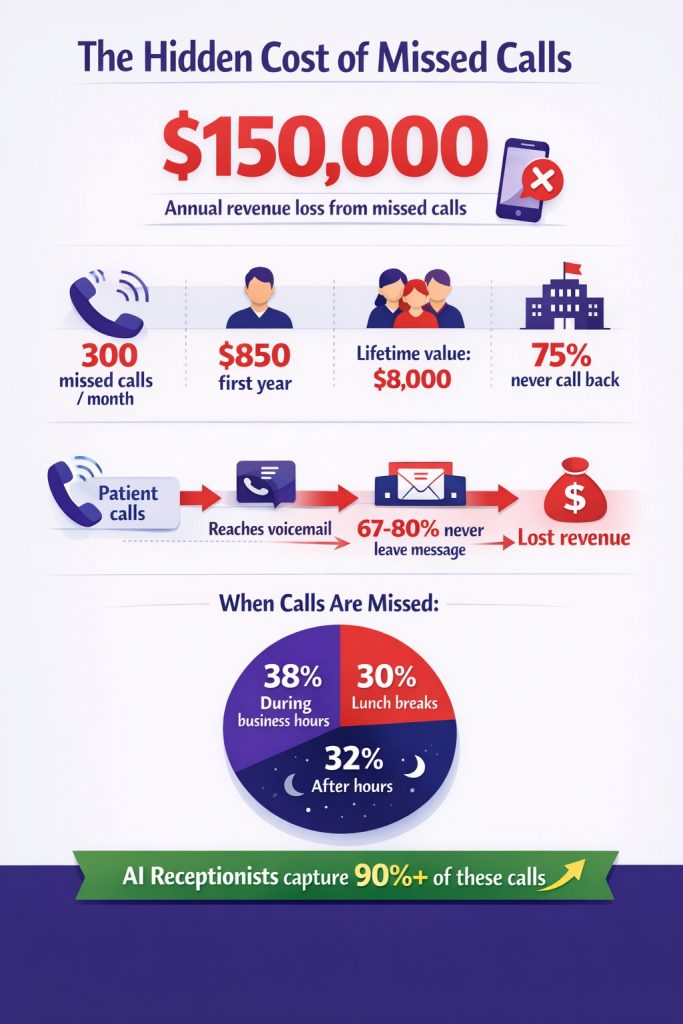
Selecting an AI receptionist requires matching your specific practice needs to available solutions. Research from Resonate App shows that the average dental practice misses 300 calls monthly, costing $100,000-$150,000 annually. The right AI system captures these opportunities while fitting your budget and workflows.
📞 Assess Your Call Volume
Track calls for two weeks to understand your baseline. Small practices (50-100 daily calls) need different capabilities than high-volume offices (200+ calls). Calculate how many calls currently go unanswered during peak hours to quantify potential ROI.
🔗 Verify PMS Integration
Your AI must connect directly to Dentrix, Eaglesoft, OpenDental, or your specific dental software. Without real-time integration, staff manually enter appointments—defeating the automation purpose. Check that your exact PMS version is supported, not just the brand name.
🔒 Confirm HIPAA Compliance
HIPAA compliance isn’t optional. Request signed Business Associate Agreements (BAA), SOC 2 Type II certification, and details on AES-256 encryption. Violations cost $100-$50,000 per incident. Never compromise security for cost savings.
💰 Calculate True ROI
Include monthly fees, setup costs, and any per-call charges. Compare total costs against captured revenue from reduced missed calls. Even conservative estimates show 10-20x ROI when AI captures just 3-5 additional patients monthly at $850 first-year value each.
🌍 Consider Language Needs
Check U.S. Census data for your area to identify languages spoken at home. Spanish support matters most broadly, but urban practices may need additional languages. Multilingual AI typically costs $20-$50 extra monthly per language.
🔧 Evaluate Customization Options
Generic scripts work for basic practices, but unique workflows need customization. Can you adjust conversation flows, appointment types, and policies yourself? Or does every change require contacting support? Self-service customization provides flexibility as your practice evolves.
🧪 Test During Trial Periods
Quality providers offer 30-day trials or money-back guarantees. During trials, track specific metrics: call answer rate, successful appointment bookings, patient satisfaction feedback, and staff time savings. Compare numbers against your baseline before implementing AI. Only hard data reveals whether systems deliver promised value.
Have multiple team members test the system. Front desk perspectives differ from management views. Gather feedback from everyone who’ll work with the AI daily. Address concerns before full commitment to ensure smooth adoption.
❓ Frequently Asked Questions
How much does an AI receptionist cost for dental offices?
AI receptionist pricing ranges from $30-$300 monthly depending on features and call volume. Basic call answering starts around $30-$50/month. Mid-tier plans with appointment scheduling and PMS integration cost $100-$200 monthly. Premium plans with unlimited calls and advanced analytics run $200-$300/month. This represents 90-95% savings compared to human receptionists costing $40,000-$58,000 annually including benefits.
Will patients know they’re talking to AI?
Modern AI receptionists sound remarkably human, and many patients don’t realize they’re speaking with software. However, transparency is recommended. The AI can introduce itself naturally: “Hi, I’m the automated assistant for Dr. Smith’s office. How can I help you today?” Research shows patients accept AI interaction when it’s efficient and helpful—they care more about getting appointments booked quickly than whether a human or AI assists them.
How long does setup take?
Setup time varies from 2 days to 2 weeks depending on complexity. Simple configurations with standard PMS integration take 2-3 days. Custom workflows, multi-location setups, or less common dental software require 1-2 weeks. Most practices go live within 5 business days. The process includes connecting to your dental software, training the AI on your practice information, configuring call flows, and testing. Your team receives training during this period.
Can AI handle dental emergencies appropriately?
Yes, modern AI systems recognize emergency keywords like “severe pain,” “bleeding,” “swelling,” or “knocked out tooth.” They prioritize these calls for immediate attention. The system either books emergency same-day appointments or transfers directly to your on-call provider. Quality AI receptionists understand the difference between true emergencies and urgent concerns—someone with tooth sensitivity isn’t treated the same as someone with uncontrolled bleeding.
What happens if the AI doesn’t understand a patient?
When the AI encounters confusion or complex requests, it has fallback options. Basic systems take detailed messages and promise callbacks. Advanced systems transfer to human receptionists seamlessly. The best approach depends on your practice setup. AI systems continuously improve through machine learning—each misunderstood interaction becomes training data that prevents future confusion. Over time, your AI handles increasingly complex conversations independently.
How does AI prevent double-booking?
Real-time PMS integration prevents double-booking automatically. When the AI accesses your calendar, it sees the absolute current state including appointments just booked by front desk staff. The system respects provider schedules, blocked time, and appointment duration requirements. Advanced systems use database locking—when the AI selects a time slot for one caller, that slot becomes unavailable to other simultaneous calls immediately.
🚀 Ready to Stop Missing Calls and Start Growing Your Practice?
Join hundreds of dental practices using AI receptionists to capture every patient opportunity. With 90%+ call answer rates, 40% reductions in no-shows, and $50,000+ in captured revenue within months, the ROI is clear. The question isn’t whether to implement AI reception—it’s which system to choose.
See how MissNoCalls customizes AI reception for your practice’s specific needs. No obligation, no pressure—just honest guidance on what works best for your situation.
💡 Understanding the Impact of Missed Calls
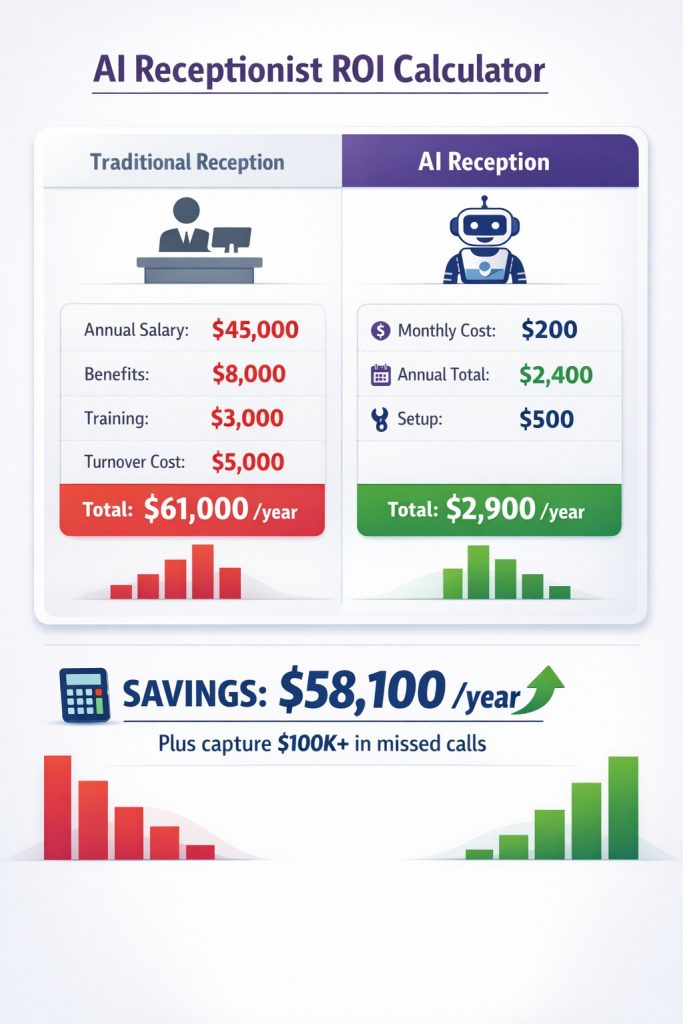
The financial consequences of unanswered calls extend far beyond individual appointments. According to DenteMax research, one in three calls to dental offices go unanswered during busy hours, and nearly 80% of missed calls relate to appointment scheduling.
Each missed new patient call represents an immediate $850 revenue loss in the first year. The lifetime value of that patient reaches $4,500 to $8,000 when accounting for ongoing care, family referrals, and multi-year relationships. When practices miss 20-30 calls monthly, the annual revenue loss exceeds $100,000.
The problem compounds during peak times. Your front desk staff juggle checking in patients, processing insurance, managing billing, and answering phones. Even exceptional teams can’t handle everything simultaneously. According to Peerlogic data, 68% of calls go unanswered and only 42% of answered calls result in appointments without proper training and systems.
24/7 AI voice agents solve this problem by answering every call instantly—during lunch breaks, after hours, on weekends, and during busy morning rushes. The economics shift dramatically: practices pay a few hundred dollars monthly to capture tens of thousands in otherwise missed revenue.
📊 The After-Hours Opportunity
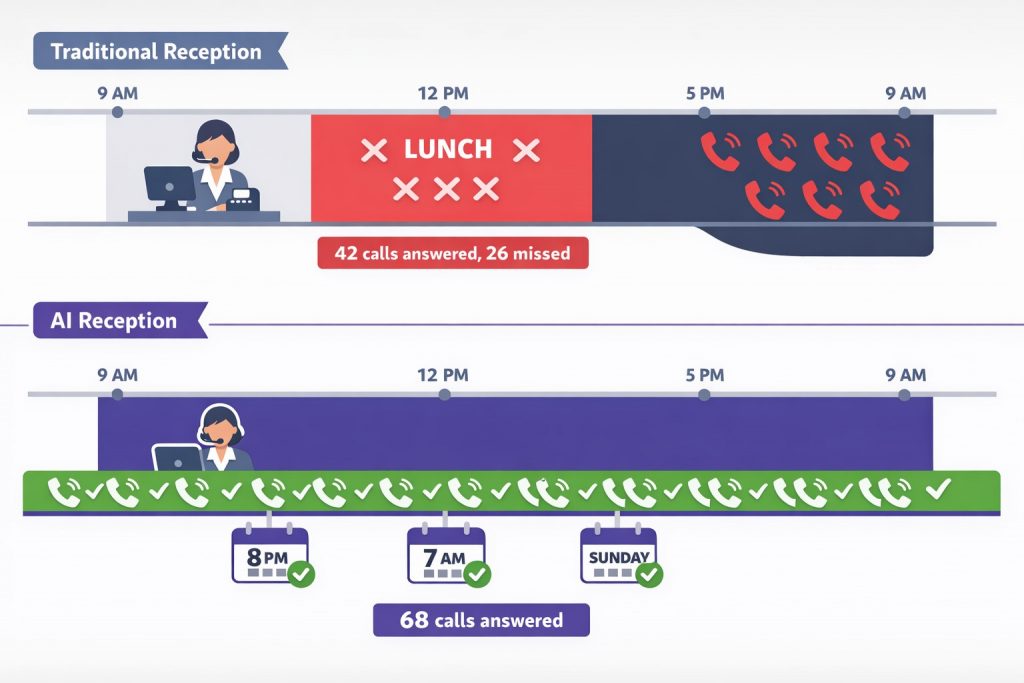
Research consistently shows that 40-50% of dental appointment bookings happen outside traditional business hours. Patients call during lunch breaks, after work, and on weekends when they have time to address personal tasks. Without AI answering services, these calls go to voicemail.
The conversion rate for voicemail is dismal. Studies indicate that 67-80% of patients who reach voicemail never call back or leave messages. They simply move to the next dental practice in their search results. These after-hours missed calls represent motivated patients actively seeking care who book elsewhere because you didn’t answer.
Traditional after-hours answering services cost significantly more than daytime coverage due to premium pay for night and weekend shifts. Many practices simply can’t justify the expense. AI receptionists work 24/7 at the same monthly rate, making comprehensive coverage affordable for every practice size.
✅ Key Takeaways
The problem is clear: Dental practices lose $100,000-$150,000 annually from 30-38% of missed calls. Each missed new patient call costs $850 in first-year revenue and $4,500-$8,000 in lifetime value.
The solution works: AI receptionists answer 90%+ of calls 24/7 for $30-$300 monthly—less than 1% of a human employee’s cost. Practices report capturing $50,000+ in new appointments within the first month, with 40% reductions in no-shows.
Implementation is straightforward: Most practices go live within 5 business days. Real-time PMS integration ensures appointments flow directly into your schedule without manual entry. HIPAA-compliant systems protect patient data with enterprise-grade security.
Choose based on your needs: Small practices benefit from customizable solutions like MissNoCalls offering flexibility at accessible prices. Large multi-location groups need enterprise features from specialized platforms. Test systems during trial periods to verify real-world performance with your actual call patterns.
The competitive advantage grows: Practices implementing AI reception today gain compounding benefits. Patient satisfaction improves when calls get answered immediately. Staff burnout decreases when automation handles routine tasks. Revenue increases as previously missed opportunities get captured. These advantages accumulate month after month, creating momentum that competitors struggle to match.